

Nectarine and Frangipane Galette
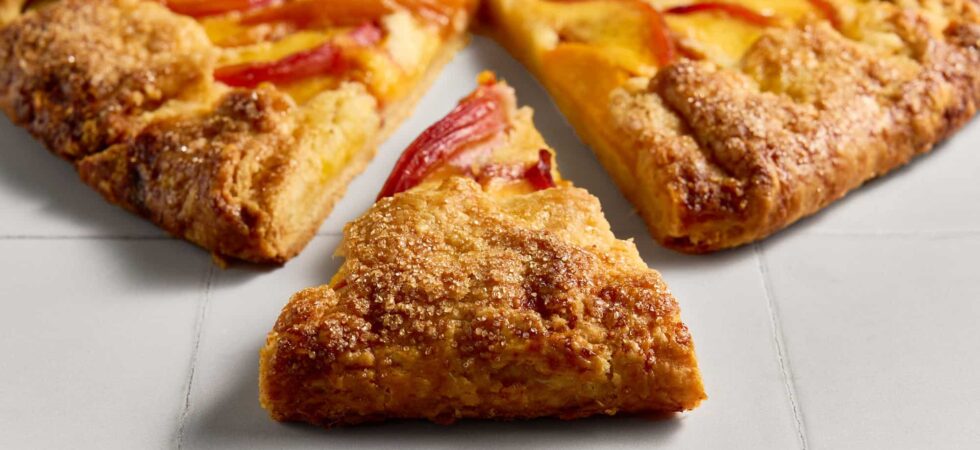
Forget 2024’s Brat Summer, 2025 is shaping up to be Galette Girl Summer™. Fruit galettes, especially stone fruit galettes, are all over my social feeds as bakers and home cooks discover how versatile and unfussy these free-form pies are. And so, I humbly enter this Nectarine and Frangipane Galette into the mix.
My pie crust uses both butter and shortening, as well as 00 Flour. Combined, they create the perfect balance between flakey and tender. To bring everything together, the pie is filled with frangipane (almond cream) and sliced nectarines for a sweet nuttiness and tangy brightness. As always, I’ve provided in-depth instructions and ingredient substitutions and explanantions, so you can make choices that are right for you and your kitchen. Happy baking!
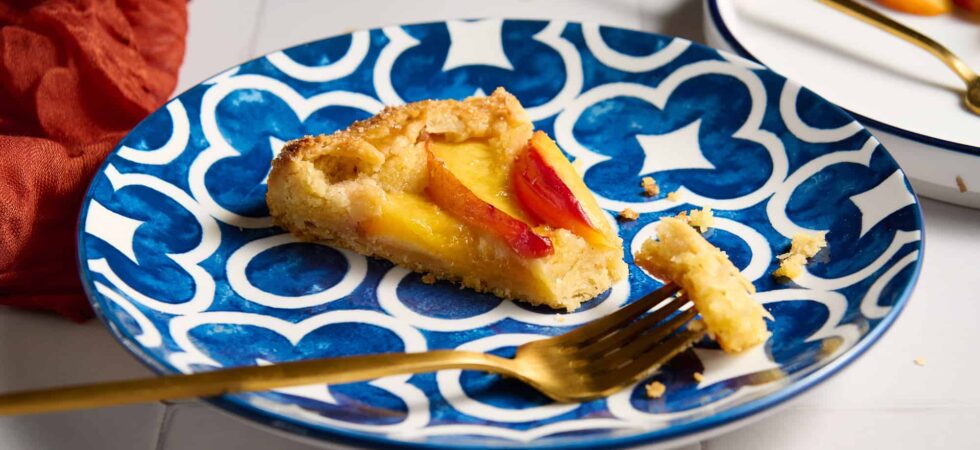
Get the Recipe: Nectarine and Frangipane Galette
Ingredients
Sweet Pie Crust
- ½ cup or 8 tablespoons European-style unsalted butter
- 3 tablespoons shortening or lard
- 1¾ cup 00 Flour
- 1 tablespoon brown sugar, packed
- ½ teaspoon Diamond Crystal kosher salt
- ¼ cup sour cream
- 2-4 tablespoons ice water
- 1 teaspoon almond extract
Frangipane (Almond Cream Filling)
- 6 tablespoons European-style unsalted butter, softened
- ½ cup refined granulated sugar
- 1 large egg + 1 egg yolk, (about 67-72g) room temperature (*save the white for the egg wash)
- 2 teaspoons pure almond extract
- ½ teaspoon Diamond Crystal kosher salt
- 1 cup almond flour
- ¼ cup 00 flour or cake flour
Nectarine and Frangipane Galette Assembly
- 2 nectarines
- 1-1½ cups frangipane
- 1 pie crust
- 1 large egg white
- 2 tablespoons water
- 1 tablespoon any stone fruit jelly or preserves, optional glaze
- ½ tablespoon water, optional glaze
Equipment
- 1 food processor or pastry cutter
- kitchen scale optional
- plastic wrap/cling film
- 1-2 medium bowls
- stand mixer or hand mixer
- paring knife
- cutting board
- Rolling Pin
- parchment paper optional (see notes)
- 2 small bowls
- pastry brush
Instructions
Sweet Pie Crust
- Measure out and cut your butter and shortening into 1/2in (1.25cm) cubes. Then, put them in the freezer while you prep everything else.
- Add the flour, sugar, and salt to a food processor and pulse 3-4 times until fully mixed. Fill a cup with ice and water and mix until fully chilled. Then, measure out 30ml (2 tablespoons) of ice water into a small glass. To that, add the almond extract. Last, measure out your sour cream and have it ready to go.
- Now, take the butter and shortening out of the fridge and add to the food processor. Pulse into the flour mix (3-4 times) until small pea-sized pieces form. Then add in the sour cream and pulse 1-2 more times. At this point, you can slowly drizzle and pulse in the ice water/almond extract mixture a tablespoon (15ml) at a time.
- You will probably need a little more water, so scoop some out of the ice water cup with your measuring spoon and continue drizzling. As you add water, you will see the dough lose its sandy texture and turn yellow as the flour hydrates. To test if it's ready, take off the top of the processor and pinch some of the dough between your fingers. If it sticks together, you can stop there. If it's still a little sandy and falls apart, add some more water.
- Once you have your dough ready, you want to keep it as cold and un-worked as possible. Dump everything out onto a large piece of cling wrap and fold it over the dough to compress it and finally seal it off. No kneading! The more you work the dough, the harder it will be. Rest the dough in the fridge for at least 2 hours, though. It's better overnight.
Frangipagne (Almond) Filling
- While the dough is resting, make the frangipane. About 1 hour before rolling the pie crust, bring 2 eggs to room temperature and the butter to a softened temperature (62-65°F or 17-18°C). About 15 minutes before it’s time to take the dough out of the fridge for rolling, pour the sugar into one small bowl and mix the flours and salt into a second small bowl, until uniform. Set these aside.
- When those are ready, add the butter to a stand mixer bowl with the beater attachment on. (or use a hand mixer and bowl) Beat the butter until it lightens slightly and looks spreadable, then add in the sugar and cream them together. This will take another 3-5 minutes. The butter mixture will lighten even more in color and increase in volume as it whips up.
- When properly mixed, stop the mixer and scrape down the sides of the bowl for better egg incorporation. Turn the mixer back on and add the egg and egg yolk. Let the beater whip up the mixture until the eggs fully incorporate and it takes on a thicker texture. Then, measure and pour in the almond extract followed by the mixed dry ingredients. Let the frangipane whip up until the flour is fully mixed in, then set the frangipane aside.
Nectarine and Frangipane Galette Assembly
- Time to put it all together. Move the dough from the fridge to a floured counter top. Then, roll the pie crust out until it’s about 16in (40.5cm) in diameter. Try to keep as close to a circle as possible by rotating the dough 15-30 degrees every pass of the rolling pin, much like rolling out dumpling wrappers. Now, move the pie crust to a baking sheet that's been covered with either a silicone mat or parchment paper. It's okay if it spills over the sides at this stage.
- Spoon the frangipane filling into the middle of the crust and spread leaving about a 2.5-3in (6.4-7.5cm) border. The filling should only cover an area that fits on your baking sheet as that will be the final size of the galette.
- When the frangipane is spread out, slice up each nectarine into 16 pieces. First, slice the nectarines in half, top-to-bottom, so you have an East and West hemisphere. Then, twist each side counter to each other, without bruising, to separate one side from the pit. From there, find the sharp bottom of the pit and use it to pry the pit from the other side of the nectarine. Now, slice each half into halves and then each quarter into halves and then each eighth into halves again until you have 16 slices. Repeat with the second nectarine. This should give you relatively equal pieces.
- Next, arrange the nectarine slices any way you’d like. Pour them on and spread evenly for something rustic, or arrange them in a flower pattern for some extra wow! Gently fold the pie crust over the filling in segments, leaving the middle exposed.
- Mix together your egg wash and spread it onto the crust. Make sure to get the sides of the galette as well, not just the top. And keep the coating light, otherwise you get scrambled eggs pooled on top of your crust. Then sprinkle some granulated sugar onto the egg wash if you want a little extra sweetness and crunch. When done, cover and pop the galette in the refrigerator for about 30-minutes.
- While the nectarine and frangipane galette is chilling, preheat your oven to 425°F (218°C). Then bake for 35-45 minutes. If you want to add the glaze, for some shine on the fruit, now is the time to mix it up and baste the nectarines with a pastry brush. Let the galette cool for 10 minutes before moving it to a cutting board to slice.
Notes
- If you forget to take the eggs out of the fridge before making the frangipane, don’t panic. Add them to a large bowl of tepid water to warm up quickly.
- To soften butter quickly, fill a glass jar with tap-hot water for a minute, pour it out, and then place the empty glass over the butter. The air temperature in the glass will help soften the butter without melting it.
- You can also, cut your butter into 1tbsp (14g) pats and arrange them on a plate with little overlap so they soften faster. More surface area, means faster heat transfer between the butter and the ambient air around it.
- You’ll notice how sticky/messy frangipane can be when you start spreading in on the pie crust. If you want a perfect, even disc with no mess put the frangipane between 2 sheets of parchment paper (no wax paper or aluminum foil). Shape the frangipane into a disc between the paper layers. After, place it in the freezer for 1 hour. Carefully peel up one side of the frangipane and place it back in the freezer for 15 minutes. Then, flip and peel the other side. Place the disc onto your rolled out dough and you are all set.
- Store the galette for 4-5 days at room temperature or 1 week in the refrigerator. Freeze for up to 2 months.
- This nectarine galette will work with any stonefruit, so consider using peaches, cherries, plums, apricots, and even mangos.
Nutrition
Frequently Asked Questions
A galette is a French pastry. It has three different forms: the Galette des Rois (puff pastry and frangipane cake), the Galette Bretonne or Breton (a savory tart), and a fruit galette (pie crust with fruit in the middle). This recipe is for the fruit galette, but each is meant to be unfussy, free-form, and relatively rustic.
This nectarine and frangipane galette works well with most drupe or “stone” fruits. The pit or “stone” that contains the seed in the middle of the fruit is what gives these fruits their name.
Some great stone fruit substitution options for nectarines are apricots, plums, peaches, mangoes, and cherries. Their flesh will stand up the heat of the oven and won’t lose shape in the way that berries, like blueberries strawberries might.
That’s not to say that berries aren’t good options, just that you will need less of those fruits or you’ll end up with a soupy galette on your hands.
If you do not have a food processor, you can make pie crust by hand. Mix the dry ingredients into a wide, shallow bowl. Then add in the butter and shortening. Use a fork or pastry cutter to break the butter and shortening bits apart. when you have pea sized pieces, start introducing the almond extract and ice water.
Your butter pieces will be bigger when you make pie crust by hand, so expect larger flakes and crispier crust. But it can be really nice to go by feel. It doesn’t happen a lot in baking. Enjoy getting messy.
00 flour is perfect for pie crust, for these reasons:
1. The 00 refers to how finely ground the flour is which ranges from 00 to 2. 00 flour is the finest level of ground flour and is typically made from durum wheat. Durum has great structure but less elasticity than their red wheat counterparts (all-purpose flours). Simply put, doughs with 00 flour hydrate faster and are less chewy from the softer wheat it’s made from. This makes it ideal for the tender and lighter textured pie crust we are after. But that’s not everything you need to know.
2. Let’s talk protein… Most 00 pizza flours have a higher amount of protein (12-13%). However, the King Arthur 00 Flour, which is what is stocked at my local grocery store, has 10.5%. I found that sticking to a protein content under 11% creates more tender crust and less gluten development. If you do not have access to King Arthur 00 Flour any will do. Even with a protein content in range with AP flour, the soft wheat and fine milling will still make better pie crust.
If you don’t want to purchase or can’t find 00 flour here are some other substitutions:
1. AP Flour + Cake or Pastry Flour: This feels like the opposite of easy since you’d need to purchase cake flour. But if you already have some and don’t want to buy 00 flour, this is a good substitute. Cake and Pastry flour typically have a protein content between 8-9%, while AP flour is between 10.5-12%. The lower the protein in flour, the less gluten development, and the more tender your crust will be.
Of Note: There is a fine line here. The less protein your flour and the resulting dough have, the more delicate and difficult it will be to work with before an after baking.
2. Specifically White Lily AP flour: If you can get it, White Lily All-Purpose Flour has a protein content of around 9% and it’s milled from soft winter wheat. All the good things I just reviewed in the above FAQ. I don’t have direct access to it where I live. But if you work with pie crust often and haven’t tried it, I suggest you give this AP flour a try!
3. Only AP Flour: This will result in a less tender crust, but there’s a reason this flour is labeled “all purpose”. All purpose flour works pretty universally in all bakes. It’s the fussy people like me that start branching out into all the other options. Your galette will stil be delicious. I promise.
Yes, you can make an all-butter pie crust and 86 the shortening all-together.
Here are a few things to keep in mind if you decide not the use shortnening at all. Shortening has no water content, unlike butter which is 80% fat and 20% water, which creates a flakier, softer pie crust. So, if you want to use only butter and not the combination of butter and shortening, the resulting crust will have a crisper, more cracker-like texture and a more buttery flavor. It will also brown a bit quicker and to a deeper color. Definitely still a delicious option.
Of Note: Butter is denser than shortening so use 2.5tbsp (35g) of butter in place of the 3 tbsp (35g) of shortening. Anyone else seeing a pattern here for why measuring by weight is easier than measuring by volume? Honestly how do we not always cook with metric?!?
Frangipane is an almond pastry cream that is used to fill all kinds of French desserts. It whips up into a thick custard consistency and then bakes into a dense cake-like texture. It’s great to add as a filling or layer in not just this stone fruit galette recipe. You can also tuck some into warm croissants and top them with powdered sugar. Or consider layering it onto fresh baked cream scones. YUM!
If you want to reheat your nectarine and frangipane galette or any fruit galette for that matter, just warm it through in the microwave in 15-30 second increments. Make sure the microwave is on a low setting (bread, pizza or between 10%-30% power). All baked goods will harden and turn really chewy when over cooked in the microwave.
Or put a slice or two in the oven to bake at 300°F (149°C) for 10 minutes (if it’s coming from the refrigerator) and 20 minutes (If it’s coming from the freezer).
I don’t use corn starch in this recipe for 2 reasons:
1. Nectarines and Peaches don’t break down and produce a lot of liquid the way berries do. So, a thickener, like cornstarch, isn’t a necessary ingredient to setting the filling.
2. The frangipane (almond cream) absorbs moisture as it cooks. So a lot of the liquid from the fruit ends up there.
You’re in luck! Because there is no leavener in this recipe (e.g. baking soda or baking powder) the only changes are the temperature of the oven and the time the galette bakes.
High altitudes, above 3,500ft (1,067m) have a lower boiling point, which means food browns faster. To combat this, take on a low-and-slow approach to baking the nectarine galette. Preheat the oven to 425°F (218°C). and the drop the temperature to 400°F (204°C) about 3 minutes after the pie goes in the oven. Then, bake to between 40-50 minutes. Depending on your oven and your elevation, the pie might cook a little faster or slower, but that range should do you good.
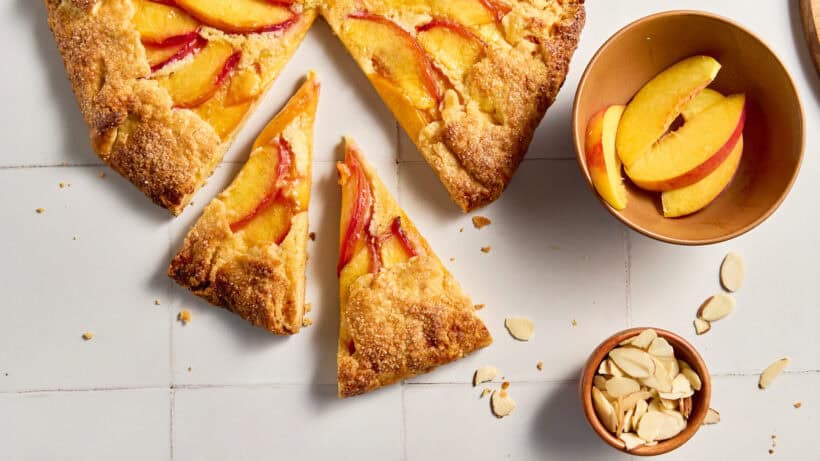
When the nectarine and frangipane galette is done the frangipane (almond cream) should have puffed up around the nectarine slices and browned a bit. The pie crust should be solid to any prodding and the bottom of your pie should be nice and dry and crisp. If it’s not, return it to the oven for a few more minutes at a time until it’s cooked to perfection.
If the crust starts browning more than you’d like, cover the fruit galette with aluminum foil, to protect it from direct heat.
I like to move my nectarine and frangipane galettes to a similarly sized cutting board or plate and cover it with cling film once it has fully cooled.
If kept refrigerated, it will last just fine for 4-5 days. I don’t really recommend freezing a galette before baking, for textural purposes, but you can freeze the whole thing right after it fully cools. Keep the crisp frozen for up to 2 months.
Why wait until “fully cooled”? Any moisture under the plastic wrap or in your tupperware will soften the pie crust, and we don’t want that.

There may be affiliate links in this post. A Little Spoon, LLC is a participant in affiliate advertising programs designed to help content creators earn fees by linking to affiliated sites.