

Cheesy Squash & Sage Soufra
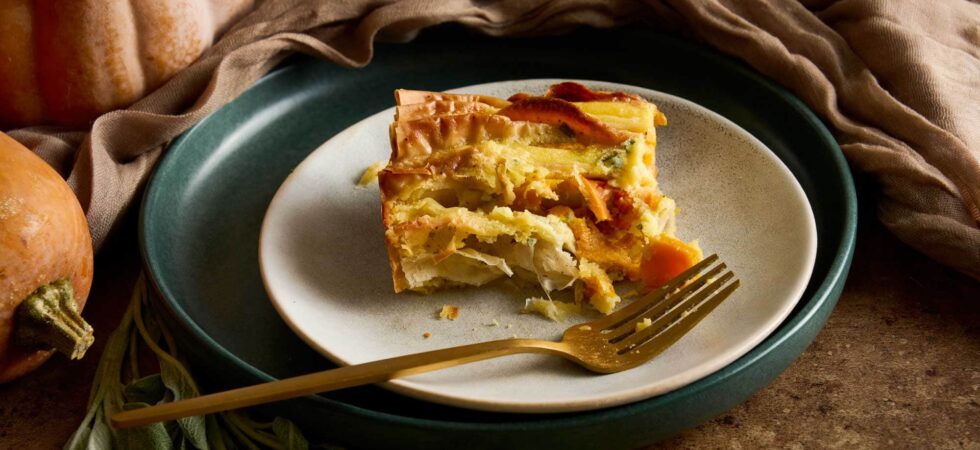
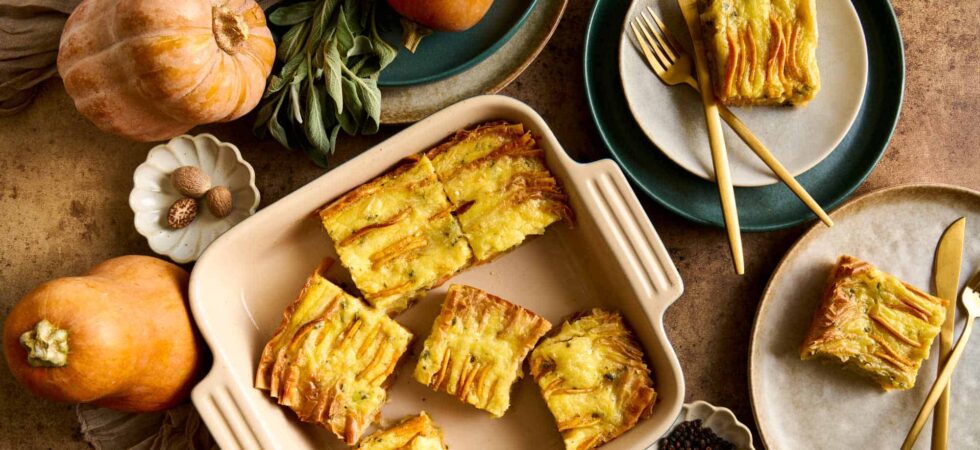
This Cheesy Squash & Sage Soufra is the perfect addition to your holiday table. Imagine thin sliced honeynut squash (or other winter squash) accordianed between layers of brown butter and sage brushed sheets of filo (or phyllo). Then everything gets smothered in a savory, cheesy custard and baked to perfection. It’s creamy and flakey and everything you could want in a cozy fall side dish. Holiday hot take… Give me a savory fall soufra over sweet potato casserole any day of the week
Get the Recipe: Cheesy Squash and Sage Soufra
Ingredients
- 1-2 honeynut squash, (see notes for several other squash options)
- 1 package filo (phyllo) pastry, (most boxes come with 2 packages)
- ½ cup butter
- 1 tablespoon + ½ tablespoon fresh sage leaves, divided as written and sliced
- 4 oz (about 1¼ cups) sharp cheddar cheese
- 1 cup heavy (double) cream
- 1 teaspoon Diamond Crystal kosher salt
- ¼ teaspoon black pepper
- ¼ teaspoon nutmeg, fresh grated or ground
- 2 eggs + 1 egg yolk, (approx. 125-130g)
Equipment
- 1 kitchen scale optional
- 1 chef knife
- 1 cutting board
- 1 mandolin or food processor with slicer attachment
- 1 spatula or whisk
- 1 small sauté pan stainless steel recommended
- 1 pastry brush
- 1 9x9in (23x23cm) casserole dish
- 1 cheese grater
- 1 small pot
- 1 medium bowl
Instructions
- Prepare the squash by first cutting off the very top and stem. Then, separate out a solid cylinder of squash by cutting just above where the seeds start and keeping the middle piece. Now, peel the skin off that center portion and cut it in half, top to bottom. You will end up with two semi circle pieces. (At this point, I recommend weighing the prepped squash, so you know if there’s a need for a second squash.) From there, use a mandolin or slicer attachment on a food processor to cut .08in (2mm) thick pieces of squash. Set the slices aside.
- Now, prepare the filo (phyllo) by taking out a single sleeve from the box and unrolling it, so the layers are all laying flat. Place them on a baking tray with cling film and then a towel over the top of them. This will keep the filo from drying out while you shape the soufra.
- When the filo is prepped, make the sage infused-browned butter. First, chop up the sage into small pieces or ribbons. Then, heat the butter in a small saucepan on medium heat. Make sure to continuously stir or swirl the pan as the butter melts and then froths. Add the sage to the pan when it starts to froth. Keep stirring and swirling. When you see the milk solids at the bottom of the pan turn a light brown color, turn off the stove and move the pan from the heat. The butter will continue to cook and should end up a nice warm brown.
- Preheat the oven to 350℉ (177℃). Then, move the browned butter pan, the sliced squash, and the filo pan to a counter top with a good amount of free space. Butter, oil, or spray the baking dish with cooking oil to grease it and place that in the workspace as well. To start, take a single sheet of filo and lay it flat on the counter. Then, use a pastry brush to gently spread the browned butter until the sheet is coasted end to end. Press a second piece of filo on top of the first and smooth them out.
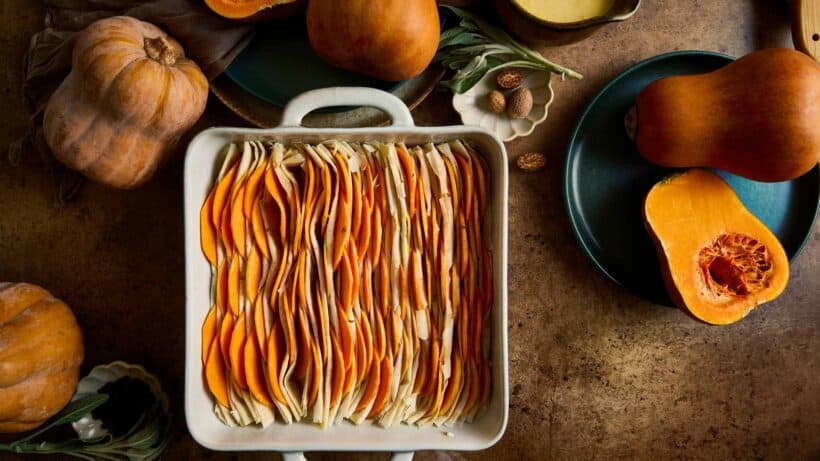
- Next, take two slices of squash and place them at the top of the filo sheets with some of the squash sticking over the edge. Accordion the filo so it folds up, over, and back down. The first row of squash should be in a kind of pocket, still protruding from the filo. Make the next row by laying a single piece of squash on the filo in the same manner as the first two. Fold the filo again, so the single slice is sticking out just as much. Next, you guessed it, use two more slices and make the same accordion fold. Continue adding slices in alternating number (1 or 2) and fold until you have used the first set of filo sheets. Place the filo and squash segment into the greased dish and begin a new one. (If the filo section ends a little too high but isn’t long enough to make another row, just fold it over to match the other fold heights.)
- Make another segment. Butter the next filo sheet and top it with a second sheet. Then repeat the accordion folds with alternating amounts of squash slices. Place the second segment and keep repeating this process until only one filo sheet is left. This sheet can get tossed or buttered. If you butter the last sheet, fold it over itself. Then, add squash and fold until it’s used up. Add the smaller segment to the dish and baste the whole thing with any remaining browned butter. when basted, put the baking dish into the oven for 25 minutes.
- While the soufra is going through it’s first bake, make the custard. Grate the cheddar cheese and chop the rest of the sage, then set them aside. In a small pot, add the cream and turn the heat to medium/medium low. Heat the cream to 150℉ (65.5℃) and keep it within a few degrees of that temperature. Then, add in the salt, pepper, sage, and nutmeg. Stir in the cheese and spices until the cheese has melted all the way and the sauce thickens but stays creamy. Take the pot off the heat and set it aside.
- In a medium sized bowl, crack the eggs and whisk them until they froth up. They should be so mixed that you cannot differentiate between the egg whites and egg yolks. At this point, check the temperature of the cheese sauce. It must be below 140℉ (60℃) before it’s added to the eggs or they will scramble. When the sauce is in the correct temperature range, temper the sauce into the eggs by slowly pouring and constantly whisking it into the eggs. Once all of the cream is added, set the custard aside.
- After 25 minutes, remove the squash and filo from the oven and let it cool for just a few minutes on the counter. Do not turn off the oven. When the filo has cooled enough to touch, pour the custard over each row. This works best if you can get custard into each pocket as far down as possible.
- Return the cheesy squash and sage soufra to the oven and bake for another 25 minutes. When done, remove the soufra and let it cool for another 5-10 minutes. At this point, the soufra is ready to cut into portions and serve.
Notes
- Other squash options are Koginut, Butternut, and Honeypatch. (See FAQs for Pro/Con info.)
- If you use a mandolin, add an extra 15 minutes to the prep time.
- An 8x8in (20x20cm) dish will also work. The ends of the phyllo will bend a bit, but it’s not a big deal.
- While you are prepping the filo, if the butter starts to thicken too much (as it cools), put it back on the burner on low or medium low to reheat it. I sometimes have to do this near the end of folding, depending on how quickly I’m working. The thicker the butter is, the harder it is to spread.
- I used white sharp cheddar when I made the recipe. If you use yellow cheddar, just remember, the custard will be more yellow than what’s pictured.
- For better custard pouring and placement, it may be easier to use a container with a spout or a ladle, though it’s not necessary.
Nutrition
Frequently Asked Questions
Wondering, “what is soufra?” You may have heard it called crinkle pie, filo pie, or phyllo pie on your socials in 2023-2024. But it is most commonly served as a Greek dessert.
Soufra is traditionally a Greek dish of sweet custard baked with filo dough. It is a kind of mix between a pie and a cake. First, you butter filo and fold it into a baking dish. Then, you enrobe the filo in custard (eggs and cream), and bake them together to make magic.
Of course, custard + filo are both what I would consider vessels for flavor. So you can understand why I and so many others make this dish our own with different flavors. In fact, you can do any of the following to change the flavor and texture to your liking. 1. Season the butter with different herbs and spices, like a compound butter. 2. Sweeten the custard in the traditional way or make it more salty/savory (like I did with the cheese). 3. Add other ingredients, like squash or apples or figs, etc to give the soufra more texture and body. See, the sky is the limit.
Soufra is best, cooled and saved in the refridgerator in a sealed container. It lasts up to 3 days in the fridge. I do not recommend freezing soufra because of the eggs and cheese. They split and get greasy at too high of a temperature, so reheating is difficult.
That being said, if you choose to feeze leftovers, let them defrost in the refridgerator before re-heating in either the micorwave or oven. Freeze soufra for up to one month, if you must.
Yes, but it will never be as good as when it’s fresh out of the oven.
That being said, there are 2 ways to re-heat soufra.
1. Baking: Reheat soufra in an oven or airfryer. It allows the filo to crisp back up quite a bit, which is the best part about these methods. Just make sure to keep the temperature low. In an airfiryer, that means as low as it will go. And, in an oven consider between 225-275℉ (102-135℃).
2. Microwave: In a microwave, heat up soufra at the lowest power in 15-30 second increments. If your microwave has any settings like, soften cream cheese, melt chocolate, or melt cheese, those are also viable options to attempt.
I have only found honeynut squash in two places. 1. Wholefoods during the fall and winter and 2. local farmer’s markets.
It’s probably easier to rely on a franchise, but if you can find any of the above squashes at a local market, I highly recommend purchasing local. The squash are always fresher. Meaning they have better texture and last longer.
There are so many fall and winter squash options to use in place of honeynut squash: butternut squash, koginut squash, and honeypatch squash are the most common substitutions for honeynut squash.
Here is a pro/con list of each squash, so you can make an informed decision when substituting the squash in this Cheesy Squash and Sage Soufra.
Honeynut Squash: This is the squash I used in this recipe because it is a sweeter and smaller version of the butternut squash. I really wanted the sweetness of the squash to come through and not be overpowered by the cheddar cheese. And, like I said before, honeynut squash are pretty small. You might need 2 of them, but you won’t have to trim them down.
Butternut Squash: On the flip side, butternut squash are much larger than honeynut squash. And, while you won’t need 2 butternut squashes, you might need to trim down the pieces, so they are not too large. If you prefer more savory dishes and a more subtle fall (gourd flavor) use this squash.
Koginut Squash: This is actually my favorite squash, and I think it would actually be the best choice for this dish flavor-wise. However, visually it won’t be as pleasing because it is bumpy. This also means it will be difficult to peel. Lastly, it doesn’t have a very large, solid neck. Koginut squashes tend to be squat with a large cavity. You would definitely need more than 2, to have enough squash for the soufra.
Honeypatch Squash: Not quite as flavorful as any of the previous squashes, honeypatch squash is still similar in flavor, but with a little less savoryness. On a positive note, it is the correct size for making this dish without the need to trim the slices down. It also has a longer neck than the koginut and honeynut. So, you might be able to get away with purchasing only 1 squash.
Sweet Potato: I know this isn’t a squash, but I did, in fact, attempt this dish with sweet potato. And it is a solid option in a pinch. The texture is different, starchier and less of a clean bite. The flavor profile is the same, though not as sweet or strong as a squash. If you cannot get your hands on squash, go for sweet potato.
There may be affiliate links in this post. A Little Spoon, LLC is a participant in affiliate advertising programs designed to help content creators earn fees by linking to affiliated sites.