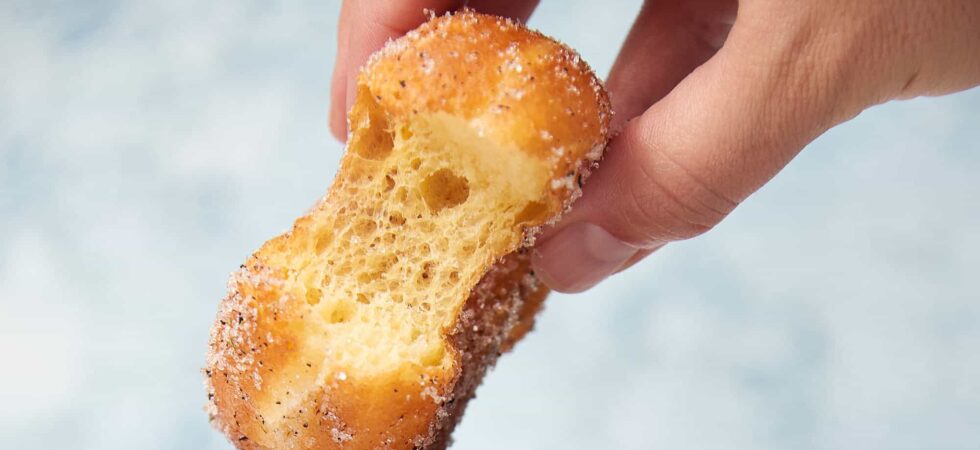
Get the Recipe: Brioche Donuts
Yeasted, fried, and oh so delicious; Brioche Donuts are the creme de le creme of the donut world. These are soft and pillowy with a lovely chew to remind you that they are bread and not pure sugar.
Ingredients
- ¾ cup warm, whole milk
- ¼ cup honey of choice
- ½ tablespoon active dry yeast
- ½ tablespoon Diamond Crystal kosher salt
- 4 large eggs, (approx. 220g)
- 3¾ cup all-purpose flour
- ¾ cup unsalted Eurpoean-style butter, softened
Equipment
- 1 stand mixer with whisk and dough hook
- 1 thermometer (optional)
- silicone spatula
- 1 very large bowl
- cling wrap (cling film) or a plastic shower cap
- 1 Rolling Pin
- 1 donut cutter
- 1 dutch oven or stock pot
- 1 metal spider
- cooling rack (optional)
Print Recipe
Instructions
- First, bring your butter and eggs to room temperature by placing them on the countertop for roughly 30 minutes before you start. To quicken things along and prep for later, slice the butter into roughly 1tbsp (14.2g) pats.
- Next, whisk the milk and honey together in a sauce pot on your stove top. Turn the heat to low and bring the mixture to about (125°F or 51°C), then pour the milk and honey into your mixing bowl.
- The temperature should come down once it hits a cold bowl. Use a thermometer to make sure the temperature has fallen between 110-115°F (43-46°C). Once you are in that window, add in the active dry yeast and let rest for 10-15 minutes so it can bloom.
- While that's working, measure out the flour and salt and set aside. Also, very lightly butter a large bowl for proofing the dough later.
- When the yeast has bloomed, turn on the mixer with the whisk attachment and add in the eggs. Once incorporated, add in salt and then flour a little at a time until it's about the viscosity of batter.
- Switch out the whisk attachment for a dough hook and continue mixing in the flour until it comes away from the sides of the bowl; It may take upwards of 15 minutes. At this point you can begin to add the butter pieces one-at-a-time. Once one mixes into the dough fully, you can add the next until all of the butter has been added.
- Continue to mix the dough until it gets shiny and you can gently touch it without it sticking to your fingers. It may need to mix for another 10 minutes to get to this stage. At any point, you can stop to do a windowpane test, to see if the dough is ready to to proof. Get your hands slightly wet and pull some of the dough up to see if it gets thin enough to see light through it without breaking. When you can do that, scrape the dough into the lightly buttered bowl and cover with cling wrap or a shower cap.
- Set it on the counter for 1-2 hours or until it doubles in size. Then, gently place it in the fridge to chill for at least 2 hours. 24 hours is best if you have the time.
- Once the brioche dough it chilled and/or cold-proofed adequately, scrape the dough onto a generously floured counter and roll it to about ½in (1.25cm) thick. Using a 3 1/2in (8.9cm) circular donut cutter, cut out all of your donuts. Try to do this quickly, as the dough will start to stick the longer it sits.
- Next, takeout the center of the donuts and place them AND each fully cut out donut on silicone lined baking sheets. Cover them with cling wrap and let them proof for 30-60 minutes or until they have doubled in size.
- While they proof, fill a deep dutch oven about 2in (5cm) high with canola oil or other neutral oil with a high smoke point and bring it up to 375°F (190°C). Keep a thermometer handy, because you want the oil to stay between that and 350°F (177°C) while frying. Prep a cooling rack or paper towels to set the cooked donuts to cool.
- To fry, take a proofed donut from the tray and place it into a metal spider strainer. Lower it into the oil and then let it cook until you can see the dough just begin to puff up. Use chopsticks to quickly flip the donut over in the oil and cook until that side is a nice golden brown, then flip the donut back over to cook the other side. Take the cooked donut out with the spider and set it aside to cool.
- Cook no more than 1-2 full donuts or 5-6 donut holes at a time, otherwise the oil temperature will drop too much. Donuts that have cooled for a few minutes can be eaten old fashioned style, dipped in a chocolate ganache, or coated in spiced sugar. (Of note: If you decide to coat the donuts in sugar, make sure they are are still warm when you do it or the sugar won't stick.) See FAQs for flavor/topping options! Enjoy!
Notes
- A note on equipment: If you don’t have a fancy donut cutter set, use a 3 1/2in (8.9cm) circular cookie cutter to make the outside cuts for the donuts. Then go back through with the base of a large piping tip (1.5in or 3.8cm in diameter) to cut out the centers. Cool right?! You can also change the size of the donuts and centers to whatever you’d like as long as you make a 1.5-2in (3.8-5cm) thick ring.
- Additionally, you can make a bunch of donut holes, but just cutting out small circles or simply leave them as big circles with no center cut to make a ring. These larger donuts are perfect for stuffing with jelly or whipped ganache.
- When frying the dough, you may need to make 1-2 before you get a feel for when to make the first flip.
- If you forget to take the eggs out of the fridge, you can add them to a large bowl of tepid water to warm up quickly.
- To soften butter quickly, fill a glass jar with tap-hot water for a minute, pour it out, and then place the empty glass over the butter. The air temperature in the glass will help soften the butter without melting it.
- If you warm the mixing bowl ahead of time by filling it with tap-hot water and then pouring it out before adding the milk and honey, you can simply heat the mixture to the top of the temperature window for blooming yeast. There's less waiting and less swing in temperature to deal with this way.
Nutrition
Serving: 1donut | Calories: 180kcal | Carbohydrates: 22g | Protein: 4g | Fat: 8g | Saturated Fat: 5g | Polyunsaturated Fat: 1g | Monounsaturated Fat: 2g | Trans Fat: 0.3g | Cholesterol: 52mg | Sodium: 249mg | Potassium: 57mg | Fiber: 1g | Sugar: 4g | Vitamin A: 279IU | Vitamin C: 0.02mg | Calcium: 22mg | Iron: 1mg