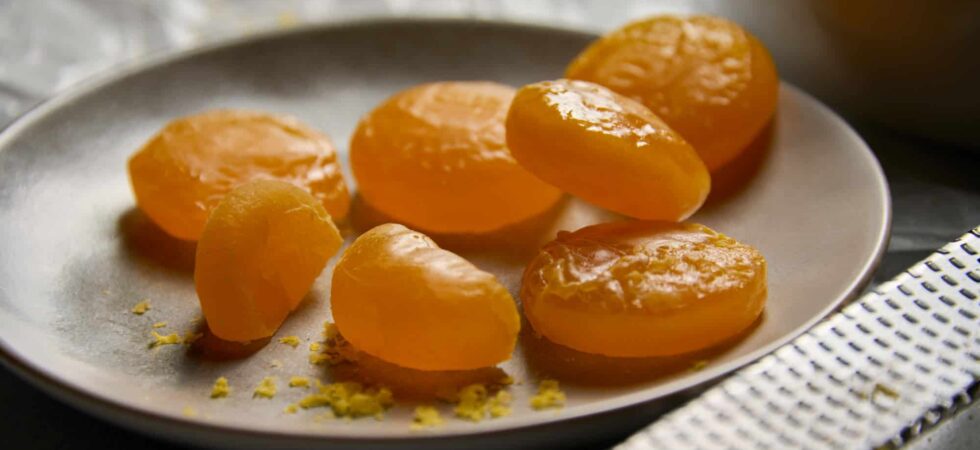
Get the Recipe: Salt-Cured Egg Yolks
Soft or hard, cured egg yolks make the perfect finishing touch to any savory dish. Bring restaurant quality flavors and techniques into your home with minimal effort. That extra pop of umami and salt will really make your dishes sing!
Ingredients
- 1 large egg yolk
- 6-8 tablespoons kosher salt or sea salt (ONLY, see notes)
Equipment
- 1 small dish or pinch bowl , something the size of a muffin tin cup
- 1 kitchen scale or measuring cups
- press and seal or cling wrap (cling film) , optional if your dish is lidded
- 1 metal spoon
- 1 cooling rack (for hard cured yolks)
- 1 baking sheet (for hard cured yolks)
- parchment paper (for hard cured yolks)
Print Recipe
Instructions
- First, cover the bottom of the dish with a little more than half the salt. The level should be around 1/2in (1.3cm) deep. Next, create a small divot in the salt where the egg yolk will cure. You can use your fingers, a spoon, or my personal favorite the wide end of the egg used in the recipe (The slope of the indentation always comes out better.) Make sure the indentation doesn't hit the bottom of the dish. The egg yolk needs to be covered by the salt on all sides.
- Now, crack the egg and gently separate the yolk from the white (albumen). Place the yolk into the salt indentation. Be careful not to break it open. Pour the rest of the salt over the top of the yolk. If you need a bit more, that's fine. The goal is to completely cover the yolk so no yellow is visible.
- Now that the yolk is prepped, cover the dish and place it in the refrigerator somewhere between 2 hours and 7 days. (2 hours will give you a lose yolk the texture of a thick caramel sauce with a slight salinity. 7 days will create a more rubber-like texture with a very, very salty taste, perfect for grating over dishes as a finishing topping.) (See FAQs for a run down on taste and texture at different curing times: 2hrs, 12hrs, 24hrs, 2 days, 5 days, and 7 days.)
- When the soft-cured yolk has cured for however long you'd like (between 2-24 hours), use a spoon to remove the yolk from the salt. Gently rinse the salt off the surface of the cured egg yolk. At this point the soft salt-cured egg yolk is done! YAY! If the goal is a hard salt-cured yolk, there is one more step to complete, dehydration.
- For a hard-cured yolk, preheat the oven to its lowest temperature setting. This is typically between 150-170℉ (65.5-67.8℃). Next, inset a cooling rack into a baking sheet. Place parchment paper over the top of the cooling rack. Once prepped, remove the yolk from the salt crust, rinse it, and pat it down with a paper towel. Then, place the cured egg yolk on the paper. Put the pan in the oven to cook. (If the oven temperature cannot go down to 150℉ (65.5℃), keep the oven door slightly open by wedging a wooden or silicone spoon into the gap.)
- Bake the egg yolk (for some, with the door slightly ajar) until the outside fully dries out and the texture feels like silicone. This can take anywhere between 90 minutes and 3 hours depending on how much moisture the yolk has before it makes it's way into the oven. Flip the yolk every 45-minutes to make sure it evenly dries on both sides. Once satisfied with the texture remove the yolk from the oven and let it cool. When cooled, the hard-cured yolk is ready to use.
This recipe assumes pasteurized eggs are being used to sigificantly lower the chance of food poisoning. Curing foods is not the same as cooking them. Curing food does not kill off bacteria, it simple slows the rate of growth. If you are not using pasteurized eggs, please read the heating instructions in the FAQs to make sure your cured egg yolks are safe to eat.
Notes
- If you don't have a cooling rack that insets with a baking sheet, you can place the cured yolk into a cupcake wrapper and place that into the oven.
- If you don't have small pinch bowls, use a muffin tin. You can make up to 6 egg yolks at a time, all with varying cure times. And you can remove each without disturbing the others by accident.
- If you have a dehydrator and don't mind the added time, substitute it for the oven. It's actually better to dry yolks between 140-145℉ (60-63℃) to maintain the best texture. But, alas, ovens are more common appliances than dehydrators, so here we are.
Nutrition
Serving: 1egg yolk | Calories: 58kcal | Carbohydrates: 1g | Protein: 3g | Fat: 5g | Saturated Fat: 2g | Polyunsaturated Fat: 1g | Monounsaturated Fat: 2g | Cholesterol: 194mg | Sodium: 2368mg | Potassium: 20mg | Sugar: 0.1g | Vitamin A: 260IU | Calcium: 25mg | Iron: 1mg